
The term “tune-up” has been part of automotive vocabulary for decades, but what it actually involves has changed significantly as vehicles have evolved. On older vehicles, a tune-up meant adjusting ignition timing, setting the fuel mixture, and replacing distributor components. On modern vehicles, a car tune-up is a comprehensive evaluation and service of the components that most directly affect engine efficiency, fuel economy, and emissions performance.
For drivers in Oak Forest and across the South Suburbs, understanding what a tune-up involves — and what technicians are actually looking for — helps you recognize when your vehicle needs one, what you’re paying for, and why the results matter for how the vehicle performs every day.
Spark Plugs: Where Combustion Begins
Spark plugs are the most well-known tune-up component — and for good reason. They ignite the air-fuel mixture inside each cylinder on every single engine cycle, which means they fire thousands of times per minute under driving conditions. A worn or fouled spark plug doesn’t ignite the mixture cleanly, which causes:
- Misfires — incomplete combustion in one or more cylinders, producing rough idle, hesitation, and reduced power
- Reduced fuel economy — unburnt or partially burnt fuel passes through the engine without producing useful power, increasing fuel consumption per mile
- Increased emissions — incomplete combustion produces higher levels of unburnt hydrocarbons that increase exhaust emissions
- Catalytic converter stress — unburnt fuel reaching the catalytic convertercauses it to overheat and degrade, potentially leading to premature converter failure
During a tune-up, a technician removes and inspects each plug — evaluating the electrode condition, the gap distance, and the color and consistency of any deposits. These observations tell the technician not just that the plug is worn, but how the engine has been running. A plug coated in black soot indicates a rich fuel mixture. A plug with a white, blistered electrode suggests overheating. A plug with normal tan-to-gray deposits indicates healthy combustion.
Air Filter: The Engine’s First Defense
The engine air filter controls what enters the intake system. A clean filter allows the correct volume of air to reach the combustion chambers. A clogged filter restricts that airflow, which forces the engine to compensate:
- The engine management system enriches the fuel mixture — more fuel is injected to compensate for reduced air, decreasing fuel economy and increasing emissions
- Power output decreases — the engine simply cannot produce full power without its designed air volume
- Throttle response dulls — the lag between pressing the accelerator and feeling the vehicle respond increases with a restricted intake
Technicians inspect the air filter during every auto tune-up service — holding it up to light to evaluate how much debris has accumulated. Replacement is a low-cost service that restores proper airflow and immediately improves combustion efficiency.
Fuel System Evaluation
The fuel system’s job is to deliver precisely the right amount of fuel to each cylinder at exactly the right moment. Over time, components in this system accumulate deposits and wear:
- Fuel injectors — carbon deposits build up on injector tips, disrupting the spray pattern and reducing atomization. A misshapen spray pattern causes uneven combustion, which shows up as rough idle, hesitation, and reduced fuel economy. Professional injector cleaning restores the designed spray pattern.
- Fuel filter — traps contaminants from the fuel supply before they reach the injectors. A restricted filter reduces fuel pressure and volume, causing hesitation under load and hard starting.
- Throttle body — carbon deposits accumulate on the throttle plate and bore, affecting how smoothly the plate opens and closes. A dirty throttle body causes erratic idle speed and rough transitions between idle and acceleration.
Ignition System Components
Beyond spark plugs, the ignition system includes components that deliver electrical energy to the plugs. These wear over time and affect how reliably and consistently each cylinder fires:
- Ignition coils — each coil produces the high-voltage spark that the plug requires. A weakening coil produces a weaker spark, which may be adequate under low-load conditions but fails to ignite the mixture under demand, causing misfires during acceleration.
- Spark plug wires (where applicable) — on vehicles with traditional distributor or coil-pack systems, high-tension wires carry voltage to each plug. Aged wires develop internal resistance and can arc to ground, causing misfires that worsen in wet conditions.
- Distributor cap and rotor (where applicable) — on older vehicles, these components distribute spark to each cylinder in sequence. Carbon tracking and contact wear reduce spark quality over time.
Fluid and Filter Checks During a Tune-Up
A thorough tune-up extends beyond the ignition and fuel systems. As Consumer Reports’ Car Maintenance & Repair Guide emphasizes, consistent maintenance across all fluid and filter systems is one of the most effective habits for long-term vehicle reliability. Technicians performing a complete car maintenance service alongside a tune-up typically evaluate:
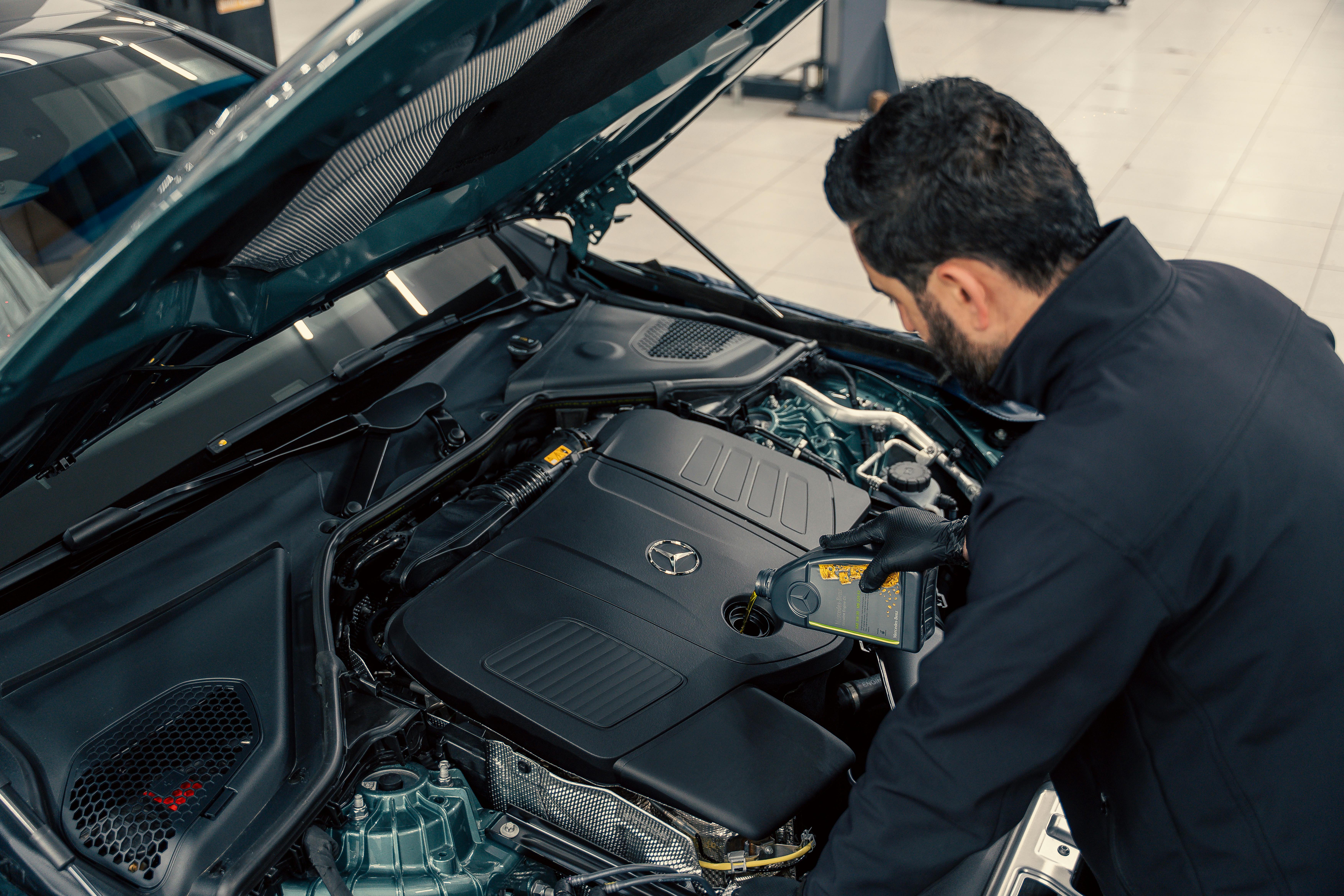
- Engine oil — condition and level checked, with a change performed if due. Oil that has degraded past its service interval loses its protective properties.
- Coolant — level and condition assessed. Discolored or contaminated coolant indicates a flush is needed.
- Transmission fluid — level and color checked on vehicles with accessible dipsticks. Dark or burnt-smelling fluid signals the need for service.
- Brake fluid — condition evaluated for moisture contamination that reduces braking effectiveness under heavy use.
- Cabin air filter — replaced if clogged. Doesn’t affect engine performance but significantly impacts in-cabin air quality and HVAC efficiency.
Belt and Hose Inspection
Serpentine belts and cooling system hoses are inspected during a tune-up because their failure modes are both common and consequential:
- Serpentine belt — inspected for cracking, glazing, fraying, and proper tension. A belt showing visible wear is flagged for replacement — because failure disables the alternator, power steering, AC, and water pump simultaneously.
- Cooling hoses — squeezed and inspected for softness, swelling, brittleness, or surface cracking. Internal hose deterioration doesn’t always show externally, which is why tactile inspection matters.
Tire and Undercarriage Evaluation
As NHTSA’s TireWise program recommends, having tires balanced and alignment checked by a qualified technician is important for vehicle safety and maximizing tire life. A tune-up provides a natural opportunity to:
- Check tire pressure and tread depth — across all four tires and the spare
- Evaluate wear patterns — uneven wear flags alignment or suspension issues for follow-up
- Visual undercarriage check — exhaust system, fluid leaks, and suspension hardware observed for obvious damage or deterioration
What You Should Expect at the End
A proper car tune-up should conclude with a clear summary of what was found, what was replaced, and what the technician recommends monitoring. No work should proceed without your approval, and every item should be explained in plain language — not technical jargon designed to upsell. A good tune-up leaves the engine running more efficiently, the vehicle performing more responsively, and the owner with a clear picture of their vehicle’s overall condition.
FAQ:
Q: How often does my vehicle need a tune-up?
A: Most modern vehicles benefit from a tune-up every 30,000 to 60,000 miles, depending on the spark plug type and manufacturer’s recommendation. Vehicles with iridium or platinum plugs typically go longer between tune-ups than those with copper plugs. Symptoms like rough idle, hesitation, or declining fuel economy may indicate a tune-up is due before the mileage interval.
Q: Will a tune-up fix my check engine light?
A: It can — many check engine codes relate directly to misfires, lean/rich conditions, or sensor readings affected by worn tune-up components. However, a check engine light should always be diagnosed with a scan tool before assuming a tune-up will resolve it. The light may indicate an issue unrelated to the tune-up scope.
Q: Is a tune-up the same as an oil change?
A: No. An oil change is one part of routine maintenance. A tune-up is a broader service that evaluates and addresses the ignition system, fuel system, air intake, filters, and engine performance — often including an oil change as part of the visit, but covering significantly more ground.
Time for a Tune-Up? We’ll Show You What Your Engine Needs
If your vehicle feels sluggish, your fuel economy has dropped, or it’s been a while since anyone looked under the hood, give us a call at 708-687-9955. At Vehicle Masters, we perform thorough tune-ups that cover every component affecting engine performance — and we explain what we find before we touch anything. Serving Oak Forest and the South Suburbs for over 30 years. Quality service, competitive pricing, customer satisfaction — we’re highly recommended.